


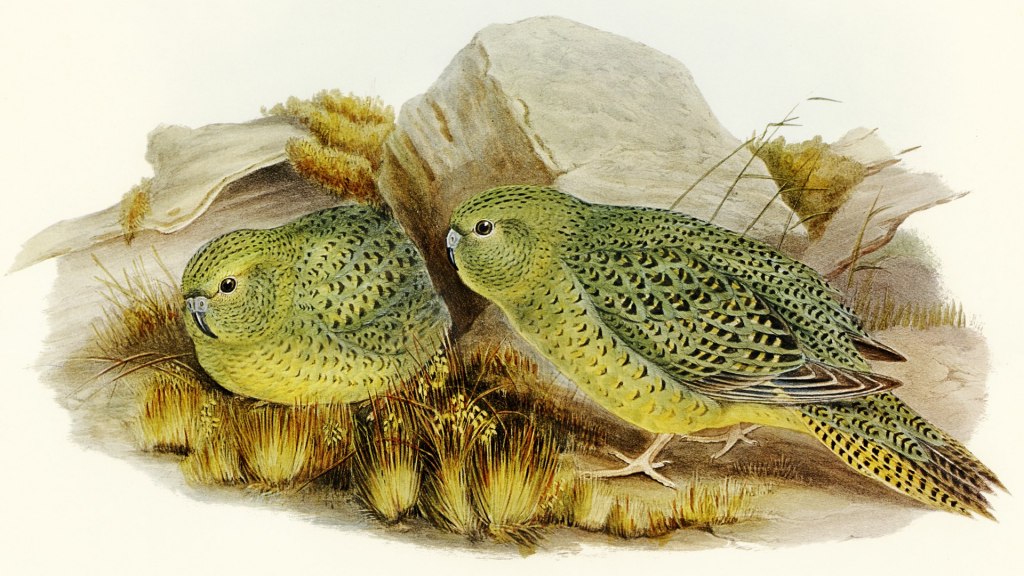
Illustratration by Elizabeth Gould (1804–1841) for John Gould’s (1804-1881) Birds of Australia (1972 Edition, 8 volumes).
Ornithologist John Gould, an English scientist who is considered the father of the study of birds in Australia, published a paper in 1861 describing a fantastic creature that was first discovered in 1845.
It was a small parrot, with a mostly dull yellow-tinged green plumage that was speckled and dusted with patches of dark brown and black. It was described as primarily terrestrial, only taking to the air when flushed or in search of water, and strictly nocturnal. Gould called it the night parrot (Pezoporus occidentalis), and it was Australia’s only nocturnal parrot species. A creature so elusive and secretive that, despite its preferred habitat of spinifex grasslands being widespread and abundant throughout the dry interior of Australia, its population and range were never fully understood. Gould originally placed it in its own genus Geopsittacus although it was later moved to Pezoporus, putting it alongside its cousin the ground parrot. All this, however, was done on mere slivers of evidence gathered from the rare occasions a specimen was found. This bird was building an almost mythical reputation for itself. Then, abruptly, everything came to a standstill.
In 1912 a live specimen was collected from Western Australia. Little did anyone know that this would be the last confirmed living record of this incredible bird for a very long time. The night parrot disappeared into the dark Australian night, melting away into the vastness of the outback and the depths of the spinifex grasses. Not a single confirmed living record of this enigmatic bird would surface for the next 100 years.
In 1979, ornithologist Shane Parker from the South Australian Museum reported 4 birds flying near Lake Perigundi, in South Australia, but did not have any photographic evidence to back up his claim. Though many celebrated this sighting as evidence of the existence of the night parrot, others treated it with caution. Understandably so.
The impossible become reality in 1990, when a research group, returning from a field excursion in the remote wilderness of Queensland, encountered a roadkill of a night parrot. Although the drought of a confirmed live sighting had stretched now for 78 years the presence of an actual specimen, recently killed, was proof that somewhere in the outback the night parrot still survived, that there was hope yet for one of the holy grail species for ornithologists.
Another quiet spell followed, punctuated by scattered sightings though none were proven or considered scientifically reliable. In 2005, 3 individuals were reported being sighted near a mining project in the Pilbara region, Western Australia. This sighting, too, was at dusk and beyond the parameters for photographs. However, the description provided by the two scientists who sighted the birds were considered so detailed that the Birds Australia Rarities Committee accepted it, making it the first accepted sighting of a live night parrot in almost a century.
In 2006, yet another dead specimen, snared this time on barbed wire, was found hanging from a fence in Diamantina National Park, Queensland. The parrots were there but in the vast outback, among the most inhospitable and unwelcoming tracts of spiky spinifex, they were proving impossible to track down.
Then, in 2013*, for the first time in over 100 years since the last recorded live specimen of a night parrot, naturalist John Young published photographs and a few seconds long video of a living night parrot, foraging in the spinifex in the dead of night. The culmination of over 17,000 hours of hunting in the darkness in the outback paying off in one, breathtaking moment. The most mysterious and secretive bird in the world was found alive once more. The location of this first sighting was kept secret to protect the bird from the fever-pitch the news caused in ornithology and wildlife groups across the world.
In 2015, ornithologist Steve Murphy and partner Rachel Barr managed to capture and tag a live night parrot in the southwest of Queensland in a moment which can only be described as monumental and legacy defining.
Since the rediscovery of the species in 2013, small pockets of night parrot populations have been discovered in Queensland and Western Australia, prompting widespread conservation efforts. Bush Heritage Australia has established and manage the Pullen Pullen Reserve, a 56,000 hectare conservation land to protect this iconic species of the outback.
The story of the night parrot is a stunning one of the secretive nature of nocturnal wildlife, the remoteness of some of Earth’s uninhabited corners, and the incredible resolve of scientists and their tireless efforts, against all odds and a hundred years, to conserve and protect.
*John Young’s research into the night parrot, specifically the discovery of nests, feathers, and call recordings in Queensland and Western Australia are believed to be falsified as per investigation by the Australian Wildlife Conservancy and were retracted by the organisation. His initial photographs and video, however, are accepted by most in the birding community as the first conclusive evidence of a living night parrot since 1912.
 Senal Siriwardene
Leave a comment