


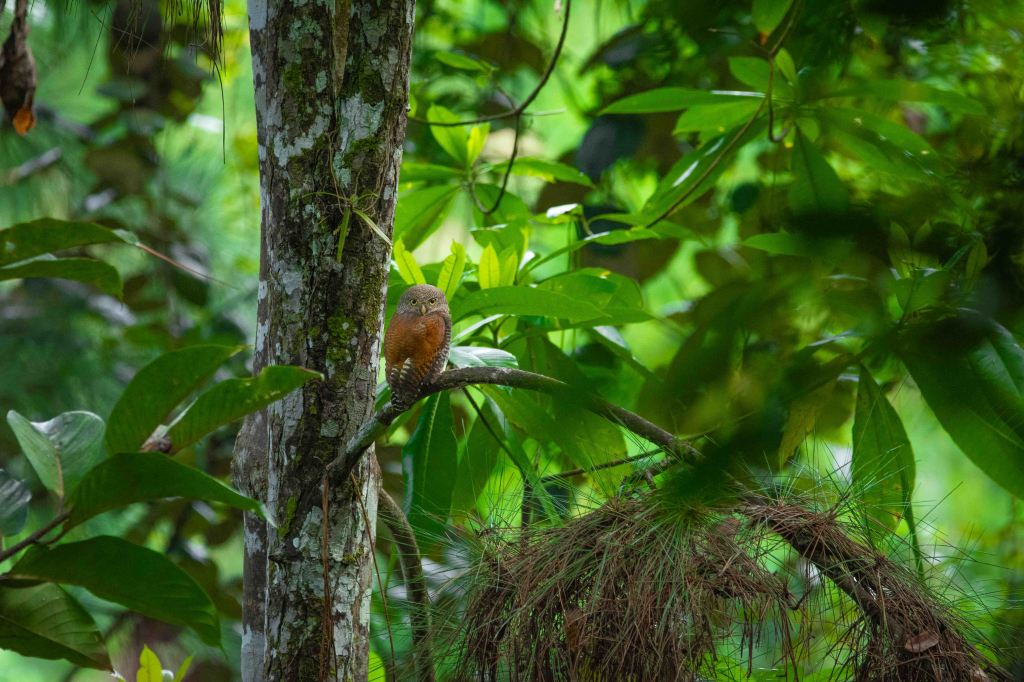
The trail underfoot was soggy. The leaf litter that covered the ground in a thick, rotting layer oozed in protest with every footstep, rivulets of black water welling between my toes. My drenched shirt hung limp, soaked in a cocktail of sweat and the occasional drizzle loosened from the canopy by the spitting wind that trailed after the rainclouds.
None of the wind made its way into the rainforest floor, however, and the air was as dense as soup and as still as a morgue. My friend and our guide, a few paces ahead of me, picked their way through giant tropical ferns, climbing vines, and rocks covered in vibrant green algae which made each step treacherous.
Around us the forest was slowly emerging after the downpour. Twittering of small birds rang from patches of ferns and from the lower branches of towering trees. We stopped our trek, squatting low, listening intently. We were close to our quarry — the leaden air was somehow charged now with the electricity of anticipation. It had been calling since the rain ended, and we had been following it for the last twenty minutes. In front of us, beyond a screening layer of ferns, the ground fell away in a steep slope into a ravine. A slip of the foot, quite an easy occurrence in that damp leaf litter, would mean a fall of several tens of metres.
Broken bones can be set. Broken cameras are a whole other story. We clutched our precious equipment tighter.
The Sinharaja Rainforest is a UNESCO World Heritage Site and a Biosphere Reserve, tucked away into the lowland foothills in south-west Sri Lanka. A dark, dense, and perpetually wet region, it’s home to a truly stunning diversity of plants, reptiles and amphibians, freshwater fish and crustaceans, and of course, birds. Nearly 90% of Sri Lanka’s endemic bird species can be found in this sprawling rainforest, which is a goldmine for ornithologists and birdwatchers. The birds are what brought me and my friend to this region two days ago. Having ticked many off our list over the past few birding sessions, we were now on the cusp of crossing off yet another name.
“Listen,” our guide whispers suddenly as ringing call sounds, echoing off the ferns and rocks about us. It comes from just in front. The ravine, despite all the dangers it poses, provides us with one distinct advantage. The canopies of the trees growing at its foot are at eye level with our vantage point and the birds who would normally be hundreds of feet above our heads are now just before our eyes and lenses.
The call sounds again, this time to our left. As we rise quietly to our feet, my foot slips in my rubber slipper and comes away sticky. I spare a second to glance at it. Our stop to listen for the call had allowed the opportunity for the ravenous leeches that litter the forest floor to latch on to my foot. More than six rubbery bodies emerge from my skin, some as thin as rubber bands while others, gorged on my blood, were as large as marbles. Where the leeches had fed and fallen off the anti-coagulant in their saliva kept my blood flowing freely to pool in my slippers.
Leeches be damned. There were birds afoot (or a-wing at least..)
I flick off what I can, ignore those who are too deeply embedded and start after my companions. My steps are now extra cautious. My foot, slick with blood, slips and slides with each step. As I catch up to my friend I can see his ankles, too, are painted red.
But our eyes are focused on the branches of the canopy, searching intently for that flash of chestnut that would give our quarry away. It has now fallen silent — no more calls to allow us to triangulate its position. That could mean two things. It has either flown away, or it sees us and has decided to make a game out of it.
“There it is!” Our guide’s outstretched finger points out what initially looks like a small fruit, or a bulbous growth on a branch directly in front of us at about twenty or thirty metres. A quick glance through our viewfinder confirms the target and my friend and I throw safety to the wind and clamber, as quietly as possible, down the slope.
I leave my slippers behind. The risk of slipping in the blood-smeared rubber is too high. I feel more confident barefoot. My camera and the deadweight of a 600mm lens combined with a good 35-degree angle tests my balance but I manage to crawl my way to a fallen, termite-riddled branch which affords a foothold.
Here I set up for my shot, trying my best to ignore the horde of leeches, drawn to my blood, now wriggling between my toes, the termites in the rotting branch viciously defending their home, and the yawning ravine before me.
That evening my friend and I sat in the verandah of the little house at the edge of the rainforest in which we were boarded. A hot cup of tea warmed our souls as blinding rain swept across the lush green curtain that rose before us. These are the times that the wildlife enthusiast in us merges with the philosopher.
“Are we insane for doing all this for a picture of a chestnut-backed owlet?” he asked. I looked at him, still bleeding from the leech bites, angry welts on his arms from the whip of thin twigs, a purple rash blooming on his neck from brushing against a disagreeable bush — a picture of suffering.
“Nah, we’d do it all again in a heartbeat.”
 Senal Siriwardene
Leave a comment