


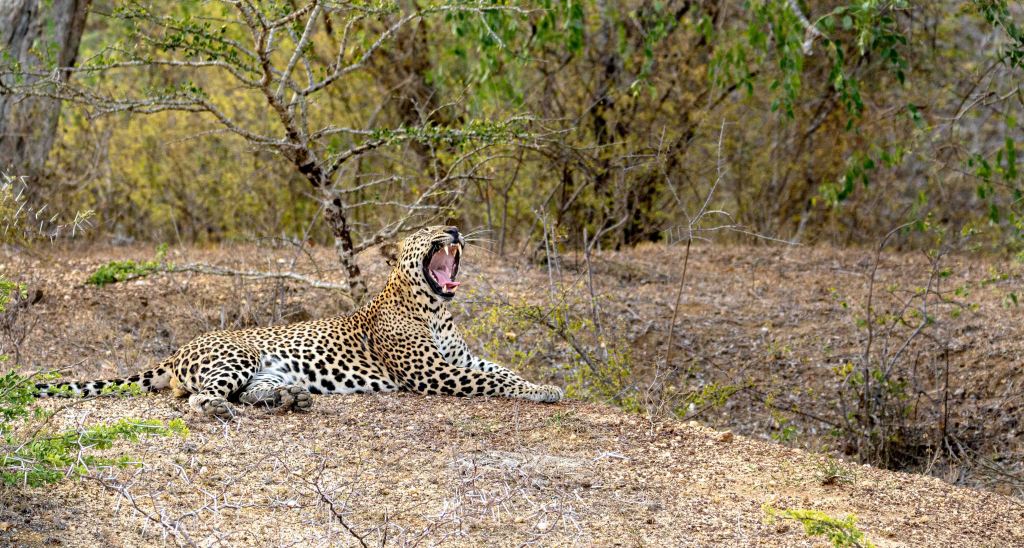
Yala National Park.
It’s one of Sri Lanka’s largest and oldest national parks and home to one of the world’s densest leopard populations, elephants, bears, deer, hundreds of species of birds, the list just goes on.
Unfortunately, Yala is also probably home to the greatest number of single-cab pickups anywhere in the world. I don’t have definite numbers on this but visit the park during the peak of the tourist season or during school holidays and you will be met with a motorcade of safari jeeps that kick up the dust as far as the eye can see. Throngs hang from the open seats on the back of the pickups that rattle and shake as the drivers jostle for position on thin jungle roads, trying to line up the perfect picture of a leopard or elephant for the trigger-happy photographers or giggling children and their exhausted parents.
Despite being a national park and a legally declared protected space for wildlife, there is a distinct feeling that animal conservation and welfare is far from the minds of the drivers and indeed the tourists that flock to Yala. The story is much the same for other national parks in Sri Lanka. Lackluster laws and, at the best of times, lukewarm enforcement of them aside, one could be excused for harboring the notion that tourism does seem to be a bane for the environment.
While there is a very valid case to be made for the detrimental effects of over-visitation on the environment, I believe that tourism, when done correctly and with genuine care for the natural world, can be a boon rather than a bane for wildlife.
Having worked in one of Sri Lanka’s leading hospitality and travel companies for 7 years and being personally involved in multiple conservation projects that the company carried out, here are some of my ideas on how tourism can help rather than hinder conservation.
Lobbying for systematic change
This is the most obvious so let’s get this out of the way early. In countries such as Sri Lanka, where tourism is a major income generator and a direct and indirect employer of thousands, hospitality companies have a significant voice in matters of national concern. No tourist wants their safari experience marred by crowded national parks and jostling jeeps. It leaves a sour taste in the mouth and ruins an otherwise magical experience. Allow the problem to go on for long enough and the influx of negative reviews and complains will force fellow visitors to reconsider their safaris – a situation which the local communities who rely on tourism and hotels can ill afford.
Hotels, acting through their representative bodies, can exert pressure on governments to bring in new rules and regulations and ensure that they are effectively enforced. It is in the best interests of all stakeholders involved that over-visitation be addressed while securing continued income to local communities and the country.
Of course, ultimately, it leads to better animal welfare as well.
Tourism as a vehicle for habitat protection
Hotels, especially boutique, experiential ones, are often set in regions of incredible natural beauty – jungles, beaches, mountains, etc. While you cannot deny that there is a degree of habitat disturbance in the construction of such properties, the potential for habitat enhancement, I believe, far outweighs the disturbance in the long term.
It is always in the best interest of a hotel to keep its surroundings as natural and pristine as possible, should that be its unique selling point. Guests who book a hotel for its wildlife encounters and natural habitat are highly unlikely to be thrilled by manicured gardens and exotic flowers. Indeed, a hotel that has understood its niche in the market and its guest demographics will often invest in planting native trees in the property to provide refuge for birds, growing wildflowers to attract butterflies, and leaving old-growth trees intact and protected.
Over time, as the surrounding landscape is swallowed up by development and agriculture, it is the property of the hotel that remains as an oasis, a sanctuary for wildlife. Multiple hotels in an area with converging values can lead to the creation of wildlife corridors along their boundaries, crucial pathways in maintaining genetic diversity in increasingly isolated populations.
Incentives for conservation
Hotels are not charitable foundations – they require profit to survive and grow. Their decisions are, for the most part, driven by cash flow. While the first impression is that this is not great – money is the root of all evil, as they say – tying conservation with income generation is a practical and sustainable way to ensure profits for the company while protecting the natural environment for its wildlife.
Many boutique hotels in Sri Lanka offer birdwatching tours in and around the properties, with paying guests from across the world flocking to see rare and endemic species. Some offer incredible nocturnal experiences, guiding guests by red-filtered flashlights to encounter the species of the night, others can offer excursions into niche subjects such as frogs, reptiles, or dragonflies. There is always a market out there for all sorts of interesting facets of the natural world.
The crucial fact here is that such tours should always be organized by a wildlife professional, considering any potential disturbance to wildlife and countering the allure of dollars with the non-negotiable condition of animal welfare. By diverting a portion of the income towards conservation, awareness, and research tourism can contribute towards the development of the wildlife sector and sustain the environment that is vital for their business.
In conclusion, there is no doubt that tourism has the potential to wreak havoc on the environment and there are countless examples of this from all over the world. But it is my experience that it is often not tourism in and of itself that is the cause of these problems but its mismanagement and weak regulations. Hotels and hospitality companies have much to offer to the natural world and to the conservation of biodiversity.
By choosing companies that genuinely work with the local environment and carry out their tourism activities in a sustainable manner, you, the guest, can influence a shift in the outlook of the entire industry and the future of the planet and all its residents.
 Senal Siriwardene
Leave a comment