


The Landcruiser rumbled out of the compound and onto the rough tarmac, headlamps lighting up the desolate Thoddaveli railway station across the lane. Only a handful of trains stopped at Thoddaveli, one of the more remote of Sri Lanka’s adventurous national railway network. Even the ticket-master only arrives at the station about a quarter of an hour before the train does.
At 5.00am, the only bastion of life was a flock of goats that had taken refuge on its platform.
The Landcruiser turned left, crossed the railway lines, and trundled down the road. To our right an enormous coconut plantation was encircled by sagging barbed wire. On our left, buildings from a bygone age. More than a few pockmarked with bullet scars.
The lane dropped us off at the A14, the rather misleadingly named Medawachchiya-Talaimannar Highway. Sure, the road started from Medawachchiya and ended at the Talaimannar pier. But a highway it surely was not. The Landcruiser swung left once more and we settled in for the jarring, shuddering drive towards the pier. We needed to be there before sunrise.
Mannar is a unique corner of Sri Lanka – an extending finger of land on the island’s north-western coast that is connected to the mainland by a thin causeway built over a vast expanse of shallow mudflats. It’s dotted with fishing villages and fishtail palms and a lifestyle that seems unchanged since the early 1900s. A small but bustling town centre with shop-lined streets greets you as you exit the causway but soon give way to scarcer landscapes. It’s truly stunning.
Mannar has been our annual pilgrimage for the last 5 years. Packing up from Colombo and driving through the night on the north-bound road through Negombo, Chilaw and Puttalam, we then turn off the well pounded thoroughfare and into elephant infested backroads, stopping only for a quick meal on a road so dark that you can’t see your hand before your face. Our destination is the Four Tees Rest Inn opposite the Thoddaveli station where we spend about 4 days every January.
The reason for this annual pilgrimage becomes apparent with sunrise.
After forty bone rattling minutes, the groaning Landcruiser finally turns into the dusty old track that falls through a quaint village and onto a grassy plain interspersed with thorny scrub. Once the engine is turned off the area is plunged into tranquil pre-dawn silence, accentuated by the gentle rumble of the surf from the beach hidden from view. The camping stove is brought out and a pot of water set to boil.
All things, big and small, must wait for tea.
As the sky lightens, the first signs of what drew the four of us to this deserted plain appear on the horizon. Dark chevrons soaring across the spreading pink stain. Ducks, in their thousands, heading towards their feeding grounds. It’s only a mere hint of the vast numbers that would follow as the sun rose higher. The bushes around us murmur and then erupt into a cacophony of twittering.
Mannar is a birdwatcher’s paradise. The mudflats, tidal plains and estuaries make the coastal regions irresistible to waterbirds and during the migratory season they flock to Mannar in their thousands. Every single body of water you pass in Mannar, no matter how large or small, or remote or next to the road, will be covered in a sea of feathers. Species from Europe, Asia, and even as far as the Americas wing their way to this corner of Sri Lanka to spend the winter months. The stars of the Mannar migration are the awe-inspiring flocks of greater flamingos that paint the salterns and low tidal estuaries pink.
It’s not just aquatic species either. The dry, thorny scrubland that covers a significant portion of terra firma acts as habitat for myriad woodland species – from the striking hoopoes to the nimble shrikes. Grey francolins, a medium sized partridge native to the northern regoins of Sri Lanka, stalk the undergrowth while black kites with their distinctive cleft tail soar in the burning blue sky. A lucky observer can even spot the jet fighter silhouette of a rare peregrine falcon.
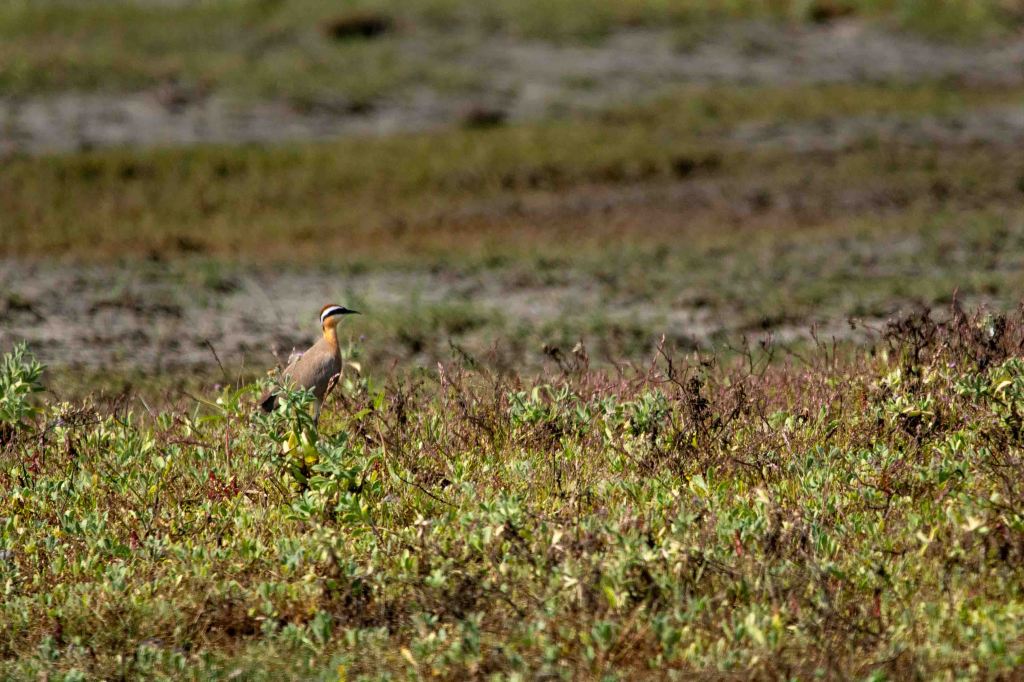
But our pre-dawn trip to Talaimannar was to spot what is probably the rarest of them all – the Indian courser. Only a handful of this large, dun coloured courser with its striking black lines over the eye can be found in Sri Lanka and here, on the arid bush that flanks the Adam’s Bridge is our best bet.
The sun is now just high enough for us to see our surroundings clearly. We pack away the stove, gulp down the last dregs of tea, pull our cameras and binoculars out of the vehicle and begin our trek across the almost alien landscape. Although difficult to distinguish at first glance, life is abundant here and flickers of movement catch our eyes.
Finally, it’s my friend who spots it. Unassuming against the background, a single Indian courser darts across the plain to our right. It’s a once in a lifetime opportunity and it’s all thanks to this wide and unique landscape that brings these species down to Sri Lanka.
The pilgrims have succeeded in their fervent purpose.
 Senal Siriwardene
Leave a comment