


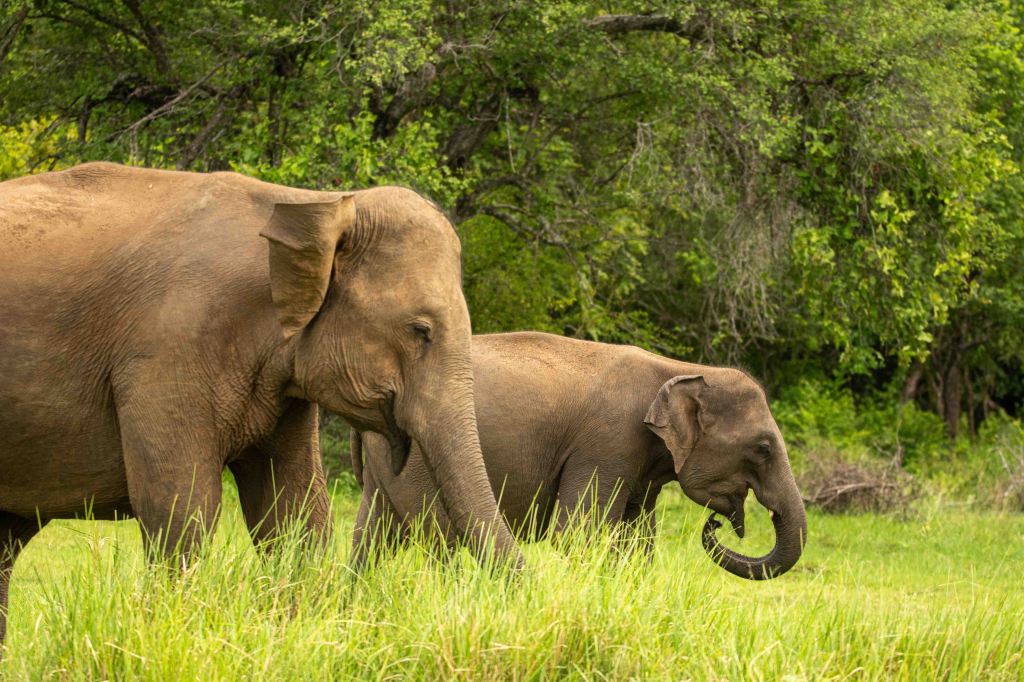
Every year from May to October, when the dry season envelopes the north-central region of Sri Lanka, hundreds of elephants (Elephas maximus maximus) begin their yearly trek through the vast floodplains of the Mahaweli River to congregate in the Minneriya and Kaudulla National Parks.
This incredible event is considered the largest gathering of wild Asian elephants on the planet, recognized by BBC Travel as one of the greatest wildlife spectacles anywhere on earth, and was set in motion a thousand years ago by an unwitting king and the need to provide water for paddy.
Sri Lanka is a pocket-sized island. Its entire landmass is spread over a modest 65,600 square kilometers and a road trip from its northern-most tip – Point Pedro – to its southern counterpart – Dondra Head – would take you less than 10 hours. It makes up for its spatial constraints by having a history that reaches over 2500 years into the sands of time. It is into this past that we must journey to lay bare the foundations for this great wildlife spectacle, to the city of Anuradhapura established in 437 BC and the seat of power on the island through successions of monarchs for a thousand years.
Being an equatorial island, Sri Lanka does not experience notable seasons. However, two monsoons and intervening droughts dictate the sway of life in this largely agrarian nation. As ancient Anuradhapura grew in power and populations swelled, the need to secure water from the monsoons for agriculture throughout the year was understood by the kings who commissioned tanks (man-made reservoirs) to be dug to catch and contain rainwater. The first tanks were relatively small, just enough for a village’s paddy fields. However, the unsatiable ambition of kings and the remarkable knowledge and growing skill of tanksmiths saw ever larger tanks hewed into the countryside as part of an intricate irrigation system, inexorably altering the landscape of the country forever – for its people and for elephants.
Prior to the construction of these giant tanks, elephants of Sri Lanka are thought to have been primarily forest dwellers. However, the lush grassy plains that flourished in the wake of irrigation schemes and abundant water drew the pachyderms from the forests to grassland and scrubland. As elephants wandered into the open plains, so did they into the very fabric of ancient Sri Lankan life. The unmistakable imprint of tamed elephants can be seen in the enormous monoliths and stones that make up the ancient kingdoms of Anuradhapura and later Polonnaruwa. There is no doubt that the might of domesticated elephants played an enormous role in the construction of the larger tanks of the late Anuradhapura period, especially during the reign of King Mahasen, Sri Lanka’s most prolific tank builder.
Ruling the country from 277 to 304 CE, King Mahasen (or Mahasena) ordered the construction of sixteen tanks and numerous canals and irrigation waterways that still form the backbone of north-central Sri Lanka’s agricultural network. His greatest creation is arguably the Minneriya Tank, a 19 square kilometer reservoir to the southeast of the kingdom. A feat that earned him the reverence of his people as minneri deviyo (God of Minneriya). Little would King Mahasen have known that his greatest creation, along with the sister tank Kaudulla he constructed to its north, would become the stage in a drama that would unfold over the next millennium.
As the dry season rolls around, the receding waters of the tanks leave behind fertile soil which transforms within weeks into lush grassland girdling the reservoirs. This abundance of food acts as a magnet, drawing hundreds of elephants from the surrounding forests and national parks to the banks of Minneriya and Kaudulla in a spectacle known as “The Gathering.” During its peak, from August to September, over 300 individual elephants can dot the horizon. From an ecological standpoint, the gathering is crucial in maintaining a healthy genetic diversity in the local elephant populations, bringing together herds that, separated by habitat fragmentation, would otherwise never meet. It affords the wildlife enthusiast the chance to observe the natural behavior of wild elephants and the photographer the opportunity to shoot stunning pictures with the serene waters of the Minneriya and Kaudulla tanks providing the perfect backdrop.
A spectacle, necessitated by the need to harvest rainwater for irrigation and set in motion by a god king over a thousand years ago – it’s truly incredible.
 Senal Siriwardene
Leave a comment